
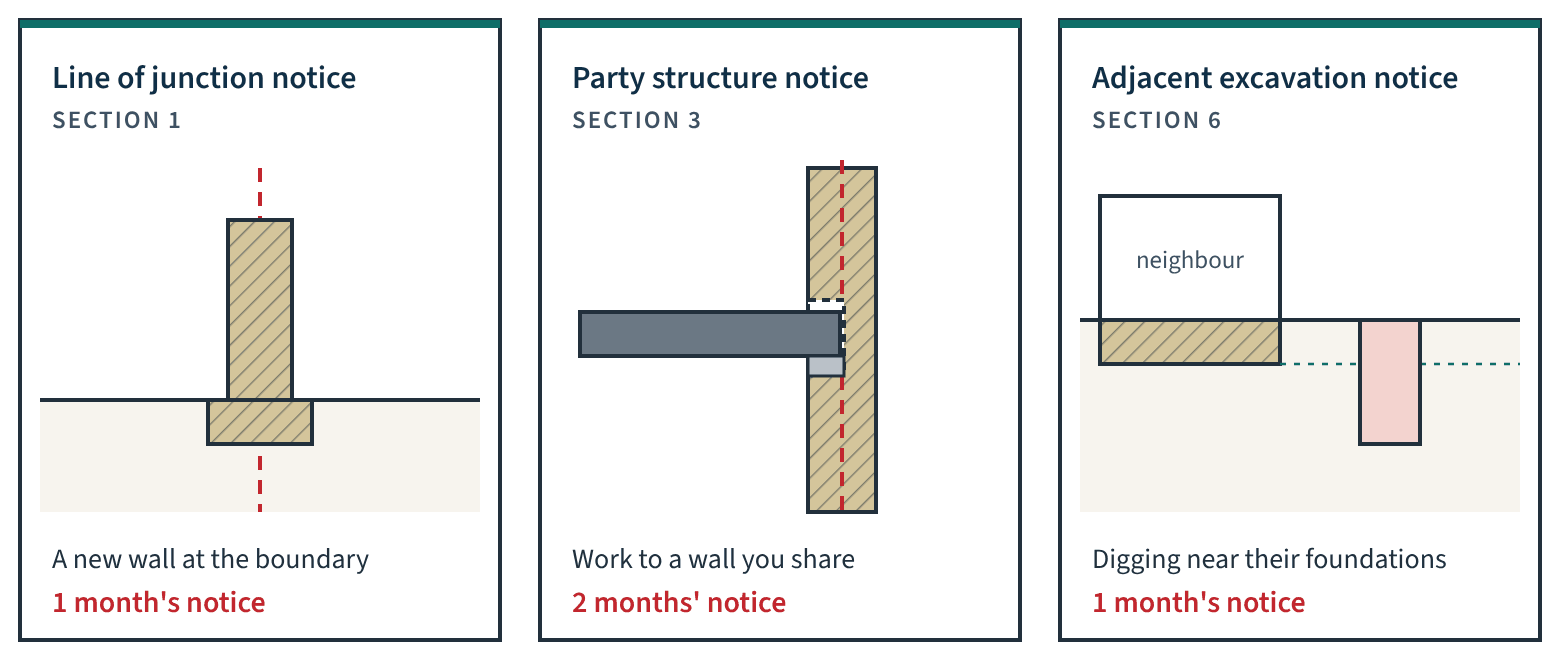
Line of junction notice (section 1)
Use this when you plan to build a new wall at the boundary line, either astride it or wholly on your own land but tight up against it. The classic example is the flank wall of a single-storey side or rear extension built right on the boundary.
If the new wall will straddle the boundary, your neighbour has to agree to that in writing. If they do not, you can still build, but only on your own side.
Minimum notice: one month.
Party structure notice (section 3, for section 2 works)
Use this for work to something you already share, most commonly the party wall between semi-detached or terraced houses. Typical examples:
- Setting steel beams or padstones into the party wall for a loft conversion
- Cutting out a chimney breast that is attached to the party wall
- Raising the party wall, or rebuilding a parapet
- Cutting in a flashing for a new roof against the wall
- Underpinning or thickening the wall
Minimum notice: two months.
Notice of adjacent excavation (section 6)
Use this when you will dig near a neighbour's building or structure:
- within 3 metres and deeper than the bottom of their foundations, or
- within 6 metres and deep enough to cut a line drawn down at 45 degrees from the bottom of their foundations.
Extension foundations, basements, lift pits and soakaways can all trigger it. Most older houses have shallow footings, so a modern trench foundation within 3 metres usually goes deeper.
Minimum notice: one month, and the notice must include plans and sections.
Common projects and the notices they usually need
| Project | Notices usually needed |
|---|---|
| Loft conversion in a semi or terrace | Party structure |
| Single-storey rear extension on the boundary | Line of junction and excavation |
| Rear extension set in from the boundary | Excavation |
| Chimney breast removal | Party structure |
| Basement | Excavation, and often party structure |
| New garden wall on the boundary | Line of junction |
This table is a starting point, not a substitute for looking at the drawings. If you are unsure, ask your designer or a party wall surveyor before serving anything. Serving the wrong notice is one of the most common mistakes.
Common questions
Can one letter cover several notices?
Each notice should be prepared separately so the details of each type of work are clear, although they can be sent to the neighbour together.
Do I need a notice for drilling into the party wall for shelves?
Ordinary fixings such as shelves, kitchen units or sockets are generally treated as minor work outside the Act. Cutting in a beam or a flashing is not minor.
Where this comes from in the Act
- Section 1: New building on line of junction
- Section 2: Repair etc. of party wall: rights of owner
- Section 3: Party structure notices
- Section 6: Adjacent excavation and construction
Links go to the official text of the Party Wall etc. Act 1996 on legislation.gov.uk.